Building Sand Table Model Production: "Micro Construction" from Drawings to Scenes
Building Sand Table Model Production: "Micro Construction" from Drawings to Scenes
The architectural sand table model is a "miniature world" that condenses elements such as architecture, terrain, and scenes in proportion, and is widely used in military, urban planning, industry, and other fields. As a model factory, mastering the entire production process logic is the core competitiveness. The following are the key steps from design to implementation of building sand table models: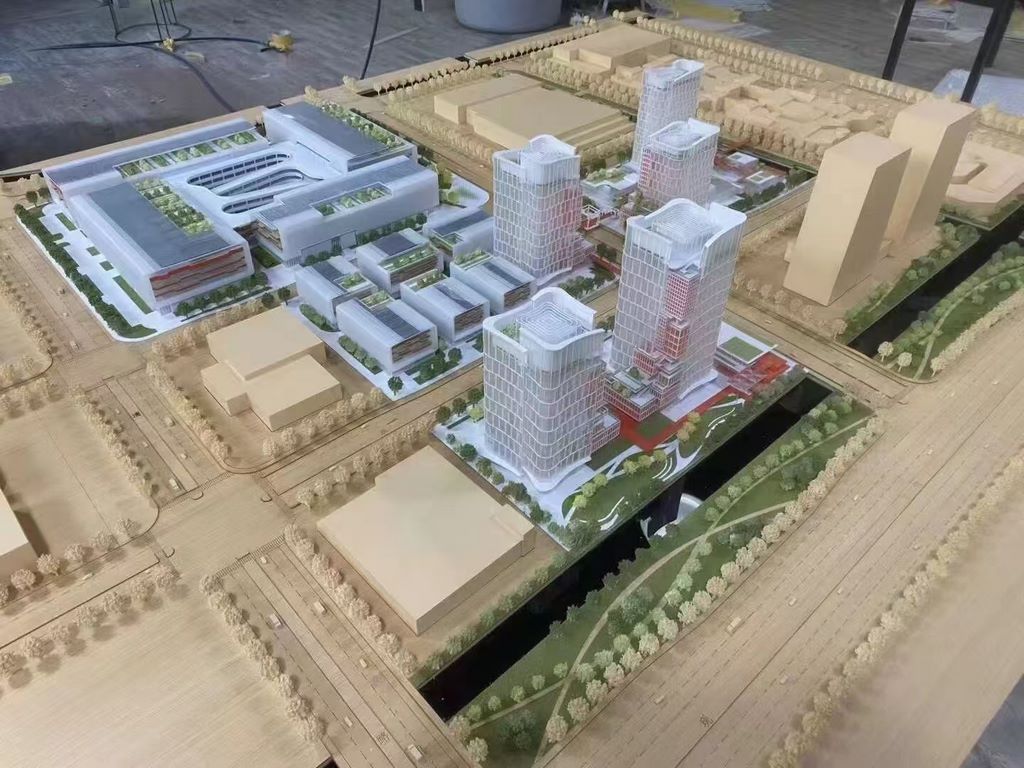
1、 Preliminary Preparation: Drawing Analysis and Technical Planning
Before making a sand table, it is necessary to clarify the scale and functional requirements (such as military sand tables focusing on terrain, urban sand tables focusing on architectural details).
Drawing conversion: Import architectural/topographic drawings from CAD, SU and other software into a computer, use a laser engraving machine to cut PVC boards, organic glass and other materials, and generate the basic framework of building contours, roads, and landforms.
Technical evaluation: Based on project requirements, plan for "static display" or "dynamic demonstration" (such as military sand tables can simulate night battles with lights, urban sand tables can simulate water systems with flowing water), and prepare equipment such as motors, lights, and electronic components in advance.
2、 Base and countertop: a stage for building a "miniature world"
The base is the "foundation" of the sand table, which needs to balance stability and aesthetics:
Structural construction: Use wooden keel as the base frame and large core board as the tabletop to ensure load-bearing and flatness; If it is necessary to hide the circuit, wires can be laid on the lower layer of the base, and a table fence can be built around it.
Tabletop paving: According to the scene requirements, lay simulated lawns (simulated green spaces) and cement roads (simulated roads) to provide a foundation for subsequent building and terrain construction.
3、 Architecture and Terrain: Restoring 'Microscopic Reality'
Architecture and terrain are the core of the sand table, and it is necessary to achieve "seeing the big from the small" through material selection and process details:
Architectural production:
Basic framework: Build the building outline with PVC board and organic glass, cut out details such as doors, windows, balconies, etc;
Detail coloring: Use a brush to color doors and windows, add copper wire and enameled wire to simulate circuits, use yarn powder and thick fishing line to simulate vegetation, and make the building come to life;
Dynamic elements: Placing cars and character models, simulating interactive scenes (such as soldiers in military sand tables and pedestrians in urban sand tables).
Terrain shaping:
Landform simulation: stack mountains and rivers with sponge, foam and other materials, and restore vegetation with gummed paper and lint;
Water treatment: Using organic glass panels to simulate water surfaces, combined with lighting to create a "sparkling" effect, enhancing the realism of the scene.
4、 Details and functions: turning "models" into "scenes"
The details determine the immersion of the sand table, which needs to be polished from micro to macro in all aspects:
Microscopic details: Add small elements such as sidewalks, lanes, and street lights to the surface of the building, simulate wires with thick fishing lines, and make the scene more rich;
Macro functionality: Test dynamic devices such as lighting and motors to ensure that functions such as "flow of water, switching of lighting" are functioning properly; Check the proportion coordination between the building and the terrain to achieve overall visual harmony.
5、 Maintenance and iteration: Keep the 'model' shining continuously
After the sand table production is completed, a maintenance mechanism needs to be established:
Daily cleaning: Regularly clean dust and check the firmness of model components (such as cars and figures);
Functional maintenance: Test lighting, motors, and other equipment to promptly repair faults;
6、 Craftsmanship and Innovation: From "Copying" to "Creating"
Sand table making is not only about "making models according to drawings", but also a combination of craftsmanship and creativity:
Craft learning: proficiently master material properties (such as transparency of organic glass, toughness of PVC board), and use different materials to express different textures;
Natural observation: studying the structure of real buildings and the texture of terrain to make the sand table more grounded;
Technology integration: Combining 3D printing and technology, upgrading the sand table from a "static display" to an "interactive experience" to enhance competitiveness.
The production of architectural sand table models is a balance between technology and art - it requires both precise reproduction of drawings and the use of details to bring the model to life. As a model factory, only by continuously cultivating in material selection, process details, and creative iteration can we stand out in the competition and make the "micro world" the core tool for enterprise display, teaching, and decision-making.


