Analysis of the entire process of industrial display model production
Analysis of the entire process of industrial display model production
Industrial display models are important carriers for enterprises to convey technological strength, showcase product charm, and popularize industrial knowledge. Their production process combines professionalism and artistry, requiring a balance between restoration, aesthetics, and practicality in order to accurately present the core features of industrial equipment, production lines, or factories. Unlike ordinary models, industrial display models need to adhere to the rigor of industrial scenes, from material selection, process polishing to post production coloring, every step needs to be refined to create high-quality models with a restoration degree of over 90% and both display value and educational significance. Based on the characteristics of industrial scenarios, the complete production process of industrial display models is analyzed in detail, providing clear guidance for enterprises to produce industrial display models.
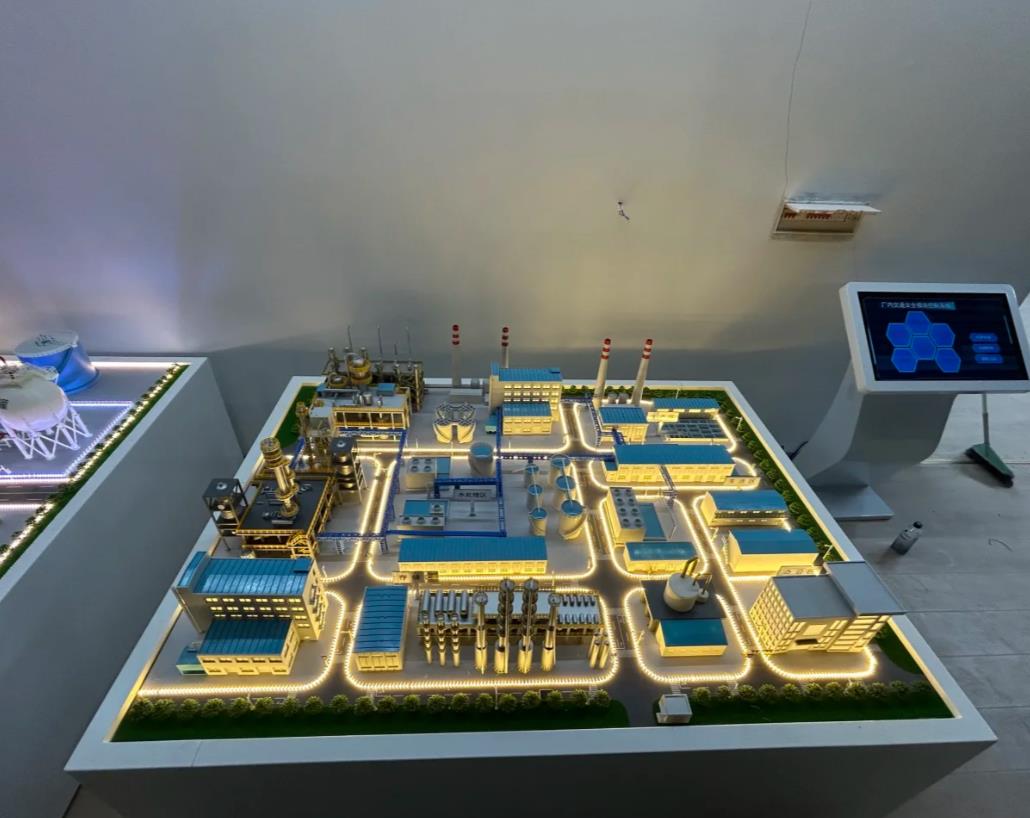
Material selection is the foundation of industrial display model production, which directly determines the texture, stability, and fidelity of the model. It needs to be combined with the characteristics of industrial products, taking into account practicality and visual presentation effects. The selection of core materials should follow the principles of "fitting the prototype, easy to process, and matching texture": ABS board and 3D printed photosensitive resin are preferred for the main structure. ABS board material is hard and easy to cut and polish, suitable for making equipment frames, factory buildings, and other regular structures; 3D printing photosensitive resin can accurately reproduce the precise details and complex surfaces of equipment, making small components such as gears, pipelines, valves, etc. more realistic. For the metal components of the equipment, ABS sheets with metallic texture or ordinary sheets sprayed with metallic paint can be used to simulate the metallic luster and texture of industrial equipment; Transparent components such as equipment windows, pipelines, etc. are made of high transparency acrylic material to ensure both transparency and structural strength. In terms of auxiliary materials, model specific environmentally friendly glue, fine sandpaper, multi-color industrial paint, UV printed label stickers, matte varnish, etc. are selected to ensure the firmness of the model, improve the texture of details, and avoid problems such as delamination and paint peeling in the later stage.
Craft polishing is the core of industrial display model production, which needs to be carried out step by step, with precise control of every detail to ensure that the model proportions are coordinated, the structure is neat, and the details are realistic. Firstly, the base and frame are made. Based on the size and layout of the industrial prototype, ABS boards are cut and spliced into a model base and main frame. Through polishing and leveling, the base is ensured to be flat and the frame is square, laying the foundation for subsequent component installation. Subsequently, the production of core components is carried out. For precision parts and complex surfaces of the equipment, 3D printing is used for integrated molding. After printing, fine polishing is carried out to remove burrs, correct defects, and restore the texture and shape of the components; For regular components such as pipelines, guardrails, platforms, etc., laser cutting or manual cutting is used to ensure precise dimensions and smooth edges, and then fixed by adhesive to restore the structural logic and layout of industrial equipment. Finally, the overall assembly is carried out by splicing the frame, core components, and detailed accessories in proportion to the prototype, adjusting the position and angle of each component to ensure a tight fit and coordinated proportion of the components. At the same time, positions for post-processing such as identification and lighting are reserved to ensure the stability of the overall structure and visual unity.
Post processing and coloring are key to enhancing the texture of industrial display models and restoring the atmosphere of industrial scenes. They need to balance authenticity and aesthetics, avoid excessive decoration, and conform to the rigorous style of industrial scenes. Firstly, carry out preliminary polishing treatment to comprehensively polish the entire model, remove splicing gaps, burrs, and edges, and make the surface of the model smooth and flat, ready for coloring. The coloring process adopts a layered spraying process, following the principle of "clear color separation and texture fitting": the main body of the equipment mostly uses industrial colors such as industrial gray, deep blue, silver gray, etc., with uniform and particle free spraying, simulating the stable texture of industrial equipment; Metal components are painted in metallic colors, simulating the luster and usage traces of metal through gradient spraying to enhance realism; Detail components such as valves, warning signs, etc. are separated into prominent colors such as yellow and red to enhance functional recognition; Pipelines are distinguished by different colors according to their functions, making the operational logic of the equipment clearer. After coloring is completed, a layer of matte varnish is sprayed as a whole, which can enhance the wear resistance, dust prevention, and oxidation resistance of the model, extend the display life, and preserve the delicate texture of the material, avoiding the impact of overly bright paint on the realism of industrial scenes. Finally, the equipment name, function identification, etc. are produced through UV printing and accurately pasted in the corresponding positions, making the model more informative and display oriented.
Detail optimization is the final step in the production of industrial display models and the key to improving model fidelity. After production, conduct a comprehensive inspection of the model, correct details such as component spacing and splicing gaps, clean up surface dust and impurities, and ensure that the appearance of the model is clean and the details are neat; Test the structural stability of the model to avoid component looseness and detachment, ensuring that the model can be used for long-term display; For models that require adding lighting, embed micro LED lights to simulate the light and shadow effects of device operation, enhancing the immersion of the display. In addition, according to display requirements, a simple base can be used to label the model name and enterprise information, enhancing the overall display effect of the model.
The production of industrial display models is a combination of craftsmanship and professionalism, and every step needs to balance rigor and aesthetics in order to accurately reproduce the core features of industrial products and convey the technological strength of the enterprise. From precise material selection and matching, to meticulous craftsmanship and polishing, to meticulous post-processing, each step determines the quality and display effect of the model. A high-quality industrial display model can not only visually present the structure and function of industrial equipment, but also become an important carrier for enterprises to showcase their strength, communicate with customers, and popularize technology, empowering and adding strength to the development of enterprises.


