Urban light rail model manufacturer
Case Study of Urban Light Rail Model Production: A Craft Journey from Zero to 90% Restoration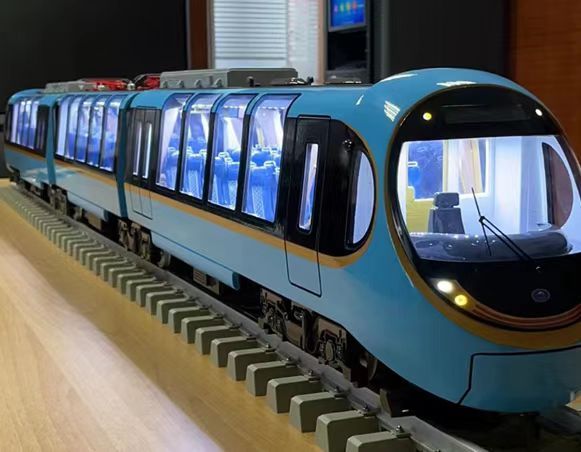
1、 Material selection: laying the foundation for reducing degree
Main material:
ABS plastic sheet: used for the main structure of light rail car bodies, carriages, etc., it has the characteristics of easy cutting, high strength, and smooth surface, suitable for shaping streamlined car bodies;
Transparent acrylic board: making transparent components such as car windows and headlights, simulating the transparency of real light rail;
Metal alloy wire: used to make metal structures such as tracks and contact networks, enhancing the realistic texture of models.
Auxiliary materials:
Environmentally friendly glue and model glue: used for component bonding to ensure structural stability;
Acrylic pigment and spray paint: used for coloring and texture treatment, restoring the color and details of light rail.
2、 Production Process: Layered Restoration of "Building Blocks" Construction
Vehicle module:
Cut the outline of the light rail body using ABS board, and then create carriages (such as driver's cab, passenger carriages, etc.) in a "layered stacking" manner to ensure that the length and proportion of each carriage are consistent with the real light rail;
The window part is cut into rectangles with transparent acrylic sheet and pasted on the side of the carriage to simulate the glass effect of a real light rail.
Detail module:
Small components such as headlights, door handles, and body markings are made step by step using ABS or metal alloy, and then assembled with the body through a "plug-in+bonding" method to ensure the accuracy of details;
The track section is bent into the shape of a track using metal alloy wire and fixed on the model base to simulate the track structure of a real light rail.
3、 Post processing: the finishing touch of color and texture
Base color spraying:
The main color tone of the car body is white or light gray, and the "multiple spraying+drying" process is used to ensure that the base color is uniform and free of flow marks;
Spray red or blue on the headlights, door edges, and other areas to match the color scheme of the real light rail.
Color scheme decoration:
The light rail markings and line numbers on the side of the vehicle are accurately depicted with acrylic paint to ensure clear text and full color;
The black border around the car window is marked with a fine pen to simulate the glass frame effect of a real light rail.
Texture optimization:
The headlight part is pasted with transparent acrylic sheet to simulate the transparency of the lampshade;
Metal components such as tracks and overhead contact systems are reinforced with a "polishing+painting" process to enhance their metallic texture and luster.


