Small Size Architectural Sand Table Model for Office
Introduction
Not every architectural model needs to be a large showpiece.
Sometimes you need a model that fits on a bookshelf or desk.
A small model is practical.
It is easy to move, store, and show to clients in a private office.
That is the value of a Small Size Architectural Sand Table Model for Office.
This guide covers everything.
From ideal scales to materials, from customization to display tips.
Let us begin.
What Is a Small Size Architectural Sand Table Model for Office?
It is a miniature replica of a building or site.
Designed to fit on a standard office desk, conference table, or shelf.
A Small Size Architectural Sand Table Model for Office typically measures 30cm to 60cm on each side.
Scale is adjusted so the entire project fits within that footprint.
Unlike large exhibition models, these are personal.
They sit in your office, ready for impromptu presentations.
They are also more affordable and faster to produce.
Why Choose a Small Model for Your Office?
Large models are impressive but impractical for daily office use.
They need dedicated rooms and special lighting.
A Small Size Architectural Sand Table Model for Office sits on your desk.
You can point to it during a video call.
You can move it to a side table when not in use.
Also, small models are perfect for early‑stage design reviews.
You do not need full landscaping or interiors – just the massing and key features.
For architects working from home or in small firms, a compact model is the ideal solution.
Ideal Scales for Small Office Models
The scale determines how much detail you can show.
1:200 – A 40m x 40m building fits in 20cm x 20cm.
1:300 – A 90m x 90m site fits in 30cm x 30cm.
1:500 – A 150m x 150m site fits in 30cm x 30cm.
For a Small Size Architectural Sand Table Model for Office, 1:200 is good for single buildings.
1:500 works for small neighborhoods or campuses.
Do not go smaller than 1:500.
At 1:1,000, buildings become unrecognizable blocks.
Key Features of a Desktop Office Model
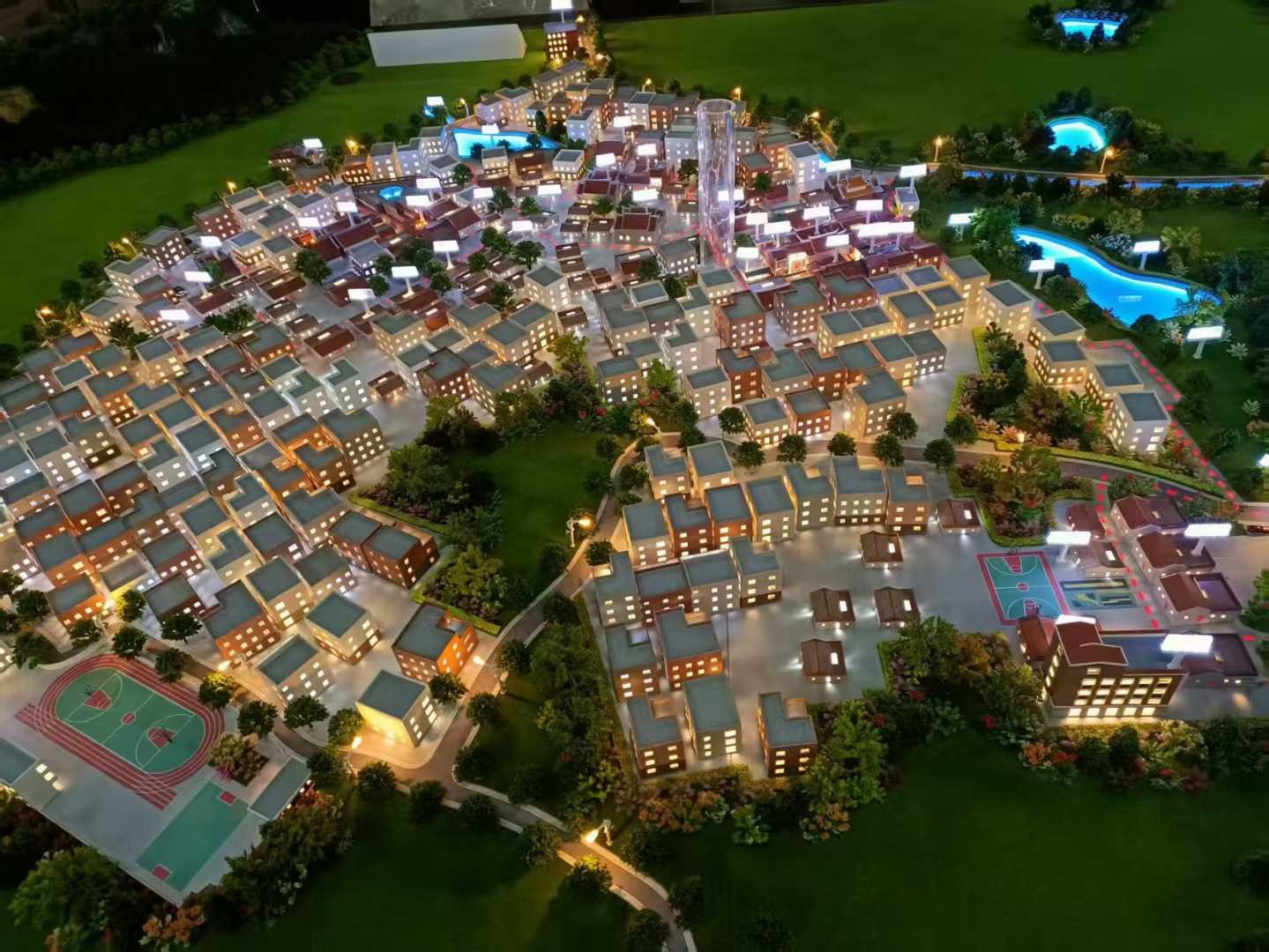
Let us break down what makes a good small office model.
Compact Base
A sturdy but lightweight base – usually MDF or acrylic.
Edges are clean and can be painted black or white.
Simplified Detail
Not every window mullion is needed.
Focus on overall massing, roof shape, and major facade patterns.
Removable Dust Cover
A small acrylic cover keeps dust off.
Essential for an office environment.
Optional LED Lighting
Some office models include a few LEDs for effect.
But keep it simple – battery‑powered, no complex wiring.
Labeling
Building names or unit numbers are helpful.
Use small printed stickers or etched acrylic.
A well‑designed Small Size Architectural Sand Table Model for Office is clear, readable, and professional.
Materials for Small Office Models
Small models use similar materials as large ones, but less of them.
Laser‑cut MDF – Affordable, easy to paint.
Acrylic sheets – For glass facades or clear roofs.
3D printed resin – For complex shapes like curved roofs or statues.
Fine sand or textured paint – For the ground.
Flocking – For small lawn areas (but keep minimal).
Magnetic base option – Allows the model to be mounted on a whiteboard for presentations.
Because the model is small, you can use higher‑quality materials without breaking the budget.
The Production Process for a Small Office Model
How is a small sand table model made?
Here is the typical workflow.
Step 1: Scale and Site Selection
You choose the building or site to be modeled.
The model maker calculates the best scale for a 30cm or 40cm base.
Step 2: Digital File Preparation
Your CAD file is simplified.
Non‑essential details (e.g., interior walls) are removed.
Step 3: Fabrication
Laser cutting or 3D printing produces the parts.
Because the model is small, fabrication takes 1–3 days.
Step 4: Assembly and Painting
Parts are glued together.
Spray paint or hand‑painting adds color.
Landscaping (trees, grass) is applied sparingly.
Step 5: Dust Cover and Base
An acrylic cover is fitted.
The base may have rubber feet to prevent sliding.
Step 6: Shipping
The model is carefully packed in foam.
A custom Small Size Architectural Sand Table Model for Office typically takes 2 to 3 weeks from order to delivery.
Applications for Small Office Models
Where are these models used?
Architect’s Personal Desk
A constant reminder of your best project.
Impress visitors who walk into your office.
Design Review Meetings
Pass the model around the conference table.
Everyone can hold it – it is light.
Client Gifts
Give a small model to a key client after project completion.
A meaningful, high‑value keepsake.
Trade Show Giveaways (High‑End)
For very exclusive events, a small custom model is an unforgettable promotional item.
Internal Coordination
An Industrial Building Architectural Sand Table Model for office use can help warehouse planners visualize rack layouts without a huge model.
Lighting Demonstrations
An Architectural Scale Model with LED Lighting in small size is perfect for testing lighting effects before scaling up.
Landscape Studies
A Small Size Architectural Sand Table Model can also serve as an Outdoor Landscape Architectural Sand Table Model for a pocket park or rooftop garden – compact enough for an office desk.
Case Study: Small Model Wins Local Planning Approval
A small architecture firm proposed a three‑story office building.
The planning committee requested a physical model, but the firm had a tight budget and limited office space.
They commissioned a Small Size Architectural Sand Table Model for Office at 1:200 scale on a 35cm base.
The model showed the building’s massing, roofline, and relationship to the street.
During the hearing, the model was placed on the committee table.
Members could pick it up and examine it from all angles.
The project was approved unanimously.
The model cost $800.
The firm saved thousands compared to a large exhibition model.
Cost Factors for Small Office Models
Small models are much more affordable than large ones.
Size – A 30cm base costs less than 60cm.
Detail level – Basic massing vs. fully detailed facade.
Materials – MDF and sand are cheap; acrylic and resin cost more.
LED lighting – Adds 300.
Dust cover – 100.
Typical range: 2,000 for a detailed, painted model with acrylic windows and a dust cover.
For a High Precision Architectural Building Scale Model in small size, add 30–50% for tighter tolerances.
How to Choose a Maker for Small Office Models
Many model makers focus on large projects.
But small models are different.
Look for makers who list “desktop models” or “presentation models”
Ask if they offer simplified detailing – not every window needed.
Check if they include a dust cover – essential for office use.
Request a small sample – a 5cm cube of their work.
Avoid makers who only produce museum‑scale models – they will overcharge you.
Display Tips for Your Office Model
Place it where it will be seen.
On a Corner of Your Desk
Within arm’s reach.
Use a small spotlamp if the room is dim.
On a Floating Shelf
At eye level on a wall.
Keep the dust cover on.
In a Glass Display Case
For a shared office or reception area.
Protects from dust and curious hands.
Always label the model with project name and scale – on the base or a small stand.
Maintenance Tips
Small models are easy to maintain.
Dust the cover weekly – Use a microfiber cloth.
If the cover is off, use compressed air – Never wipe the model directly.
Repair loose parts with super glue – Use a toothpick for precision.
Keep away from direct sunlight – Colors fade.
Common Mistakes to Avoid
Do not choose a scale too small.
1:1,000 for a building – you lose all character.
Do not add too much landscaping.
A small office model with 100 tiny trees looks cluttered.
Do not forget a dust cover.
Open models in an office get dirty quickly.
Do not make it too heavy.
A small model should be easy to lift with one hand.
Do not overpay.
For a simple massing model, 500 is reasonable.
Related Architectural Model Types
While small office models are versatile, they serve different purposes than larger types.
An Industrial Building Architectural Sand Table Model for office use might be small, but industrial projects often need to show truck turning radii – hard at 1:500.
An Architectural Scale Model with LED Lighting in small size is possible with a watch battery – great for a night‑effect desk piece.
An Outdoor Landscape Architectural Sand Table Model for a rooftop garden can be small enough for an office, but terrain sculpting at tiny scales is challenging.
A High Precision Architectural Building Scale Model in small size is ideal for patent filings or detailed design verification – the small size makes precision easier.
A Hospital Architectural Scale Model used for office planning (e.g., a small clinic) can fit on a desk and help doctors visualize room layouts.
Each type can be scaled down. Small models are not inferior – they are just focused.
Future Trends in Small Office Models
Desktop 3D printers make small models increasingly accessible.
In‑house printing – Architects print their own small models overnight.
Modular kits – Pre‑designed components snap together.
Augmented reality bases – A small physical model triggers a digital overlay on a tablet.
However, professionally finished small models will always have a place.
The quality of paint, base, and dust cover sets them apart.
Conclusion
A Small Size Architectural Sand Table Model for Office is a practical, affordable, and powerful tool.
It fits on your desk, impresses clients, and aids decision‑making.
Choose the right scale for your project.
Keep detailing appropriate to the size.
Always use a dust cover.
Whether you need a quick massing study or a polished presentation piece, a small model delivers big value.
And remember – whether you need an Industrial Building Architectural Sand Table Model for a warehouse layout, an Architectural Scale Model with LED Lighting for a night effect, an Outdoor Landscape Architectural Sand Table Model for a park design, a High Precision Architectural Building Scale Model for patent filing, or a Hospital Architectural Scale Model for a clinic, all can be created in a compact, office‑friendly size.


