Large Scale Sand Table Model Custom Project
Introduction
Some projects cannot fit on a small table.
Entire regions, transit corridors, or metropolitan areas demand a large physical model.
A small model loses detail.
Important connections become invisible.
You need a Large Scale Sand Table Model.
This guide explains what makes a model “large scale.”
Why custom projects require special expertise.
And how to get one for your city, region, or exhibition.
Let us begin.
What Is a Large Scale Sand Table Model?
It is a physical miniature that covers a wide area at a relatively small scale.
A Large Scale Sand Table Model typically spans 2 to 5 meters on each side.
Scales range from 1:2,000 to 1:10,000 or even 1:25,000.
At these scales, individual buildings are massing blocks.
The focus is on relationships between districts: highways, transit lines, rivers, and growth boundaries.
The model is used for regional planning, corridor studies, and museum exhibitions.
Why Choose a Large Scale Model for Your Project?
A large model reveals the big picture.
You see how a new transit line connects five municipalities.
You understand where green buffers prevent sprawl.
A Large Scale Sand Table Model is essential for:
Regional master plans.
Transit corridor visualizations.
Economic zone strategies.
Museum exhibits showing urban evolution.
It also supports public engagement.
Citizens walk around a large model and see their own neighborhood.
They understand proposed changes.
The Challenge of Large Scale Custom Projects
Building a large scale model is not simply scaling up a small model.
New challenges appear.
Base stability – A 4m x 3m base must not warp. Reinforced aluminum honeycomb or thick MDF is required.
Precision across distance – ±0.1mm accuracy must hold across meters. Laser cutting and CNC machining are essential.
Transport and installation – The model is built in sections, shipped, and reassembled on site.
Lighting – LED systems must cover large areas evenly.
That is why you need a specialist.
An Architectural Sand Model Custom Factory has the equipment and experience for large projects.
The Global Hub for Large Scale Sand Table Models
China’s Pearl River Delta – Shenzhen, Guangzhou, and Dongguan – is the world’s manufacturing center for architectural models.
Here, an Architectural Sand Model Custom Factory can handle large scale projects.
These factories offer:
Large‑format laser cutters (up to 2m x 3m).
CNC machining for terrain.
3D printing for landmarks.
Hand finishing by skilled artisans.
Sectional construction for easy shipping.
All under one roof.
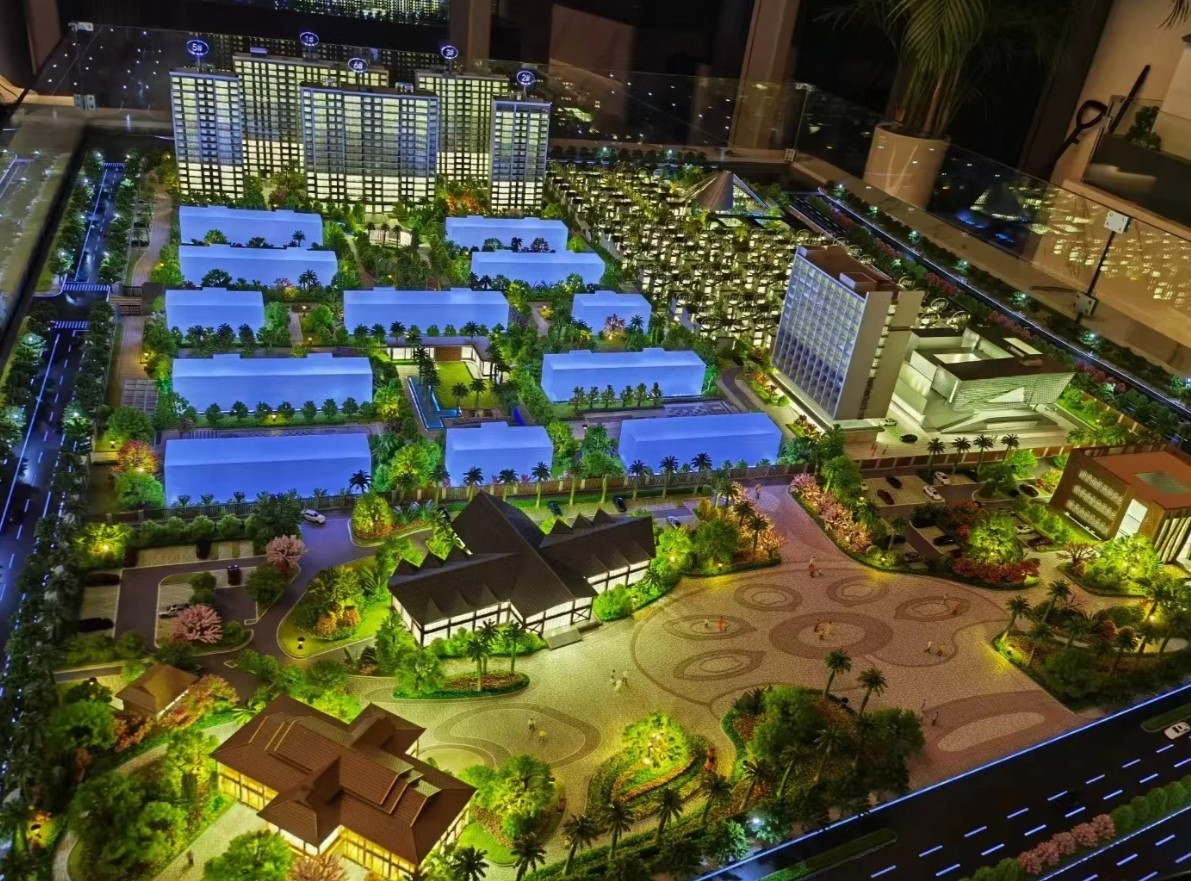
Five Large Scale Model Services You Can Access
A professional provider typically offers five specialized services for large projects.
1. Architectural Sand Model Custom Factory – Full Customization
An Architectural Sand Model Custom Factory builds your large scale model from scratch.
No templates.
Every road, river, and building footprint follows your GIS data.
2. OEM Urban Planning Scale Model Supplier – White‑Label Production
An OEM Urban Planning Scale Model Supplier produces large scale models for your brand.
You provide the design, they manufacture it.
You put your name on the finished product.
3. Bespoke Architectural Sand Table Model Service – Tailored to Your Vision
A Bespoke Architectural Sand Table Model Service offers end‑to‑end support: consultation, design, fabrication, and installation.
Perfect for unique regional visions.
4. Wholesale Architectural Sand Table Model – Multiple Identical Units
Wholesale Architectural Sand Table Model sourcing is for buyers needing several large models for different sites.
A national developer may order five identical regional models for five sales centers.
5. Export Urban Planning Sand Table Model – Worldwide Delivery
Export Urban Planning Sand Table Model services bring your large model to any country.
Sectional construction allows shipping in standard containers.
Export packaging meets ISPM‑15 standards.
The Production Process for a Large Scale Custom Model
A professional large scale project follows a rigorous workflow.
Step 1 – Data Collection and Consultation
You provide GIS data, CAD files, regional maps, and project goals.
The factory determines the optimal scale and table size.
Step 2 – Digital Modeling and Section Planning
A digital 3D model is created.
The model is divided into sections (typically 1m x 1m) for transport.
Each section is numbered.
Step 3 – Prototyping (Optional)
A small physical sample or one full section is produced for approval.
Step 4 – Precision Fabrication per Section
Laser cutting – Cuts building footprints, roads, and transit lines.
CNC machining – Shapes large terrain features.
3D printing – Produces landmarks and complex elements.
Step 5 – Hand Assembly and Painting per Section
Skilled artisans assemble each section.
Water‑based eco‑friendly paints are used.
Step 6 – LED Lighting Installation
Programmable LEDs are embedded across sections.
Wiring is hidden, with connectors between sections.
Step 7 – Quality Inspection per Section
Each section is checked for dimensional accuracy and finish.
Step 8 – Sectional Packaging
Each section is placed under a clear acrylic cover.
Sections are packed in reinforced wooden crates with foam cushioning.
Step 9 – Global Shipping
Sections are shipped together.
Air freight (7–14 days) or sea freight (20–40 days).
Step 10 – On‑Site Assembly
A technician travels to your location to reassemble sections.
Seams are hidden with landscaping details.
Step 11 – After‑Sales Support
A 365‑day warranty covers any issues.
Materials Used for Large Scale Sand Table Models
Large models use lightweight, durable materials.
Aluminum honeycomb base – Light, warp‑resistant for large spans.
ABS plastic – Lightweight building massing.
Acrylic – For water bodies and transit line overlays.
Miniature trees and vehicles – Realistic landscaping.
UV‑stable paints – Colors that do not fade.
LED strips – Low‑voltage, long‑life.
Cost Factors for Large Scale Custom Projects
Area covered – 100 sq km vs. 1,000 sq km.
Scale – 1:2,000 (more detail) costs more than 1:10,000.
Number of sections – More sections increase fabrication and assembly time.
Detail level – Basic massing vs. high simulation.
Lighting – Static vs. programmable LEDs.
On‑site assembly – Technician travel and accommodation.
Typical range: 250,000 for a very large, highly detailed metropolitan model with full LED lighting and on‑site assembly.
How to Choose a Provider for Large Scale Projects
Use this checklist.
Large‑format equipment – Laser cutters and CNC capable of handling 2m+ sheets.
Sectional construction experience – Ask for photos of shipped large models.
Quality certifications – ISO 9001:2015.
Reference projects – Request examples of models over 3m in size.
Lead times – 12–16 weeks typical for large projects.
After‑sales support – Warranty and on‑site assembly service.
Case Study: Large Scale Model for a Regional Transit Authority
A regional transit authority planned a 150‑km light rail corridor across 12 municipalities.
They commissioned a Large Scale Sand Table Model at 1:10,000 scale, covering 4m x 3m.
The model showed the entire corridor, existing highways, and proposed stations (glowing blue LEDs).
At public hearings, citizens walked around the model.
They saw how the rail line connected their town to job centers.
Opposition dropped significantly.
The model cost $95,000.
The transit project was approved.
Common Mistakes to Avoid
Do not underestimate base stability.
A warped base ruins the entire model.
Do not forget sectional planning.
If sections do not fit through doorways, you have a problem.
Do not skip on‑site assembly.
Shipping a large model pre‑assembled is impossible.
Do not ignore lighting uniformity.
LEDs must be consistent across sections.
Future Trends in Large Scale Sand Table Models
Modular sensor integration – Live traffic data displayed on the model.
AR overlays – Scan sections to see demographic data.
Sustainable materials – Recycled aluminum bases and biodegradable flocking.
Remote sectional updates – Replace a section with a 3D printed update.
Conclusion
A Large Scale Sand Table Model is the ultimate tool for regional planning, transit visualization, and public engagement.
It requires specialist skills: large‑format fabrication, sectional construction, and on‑site assembly.
Whether you work with an Architectural Sand Model Custom Factory for full customization, an OEM Urban Planning Scale Model Supplier for white‑label production, a Bespoke Architectural Sand Table Model Service for end‑to‑end support, a Wholesale Architectural Sand Table Modelfor multiple identical large models, or an Export Urban Planning Sand Table Model for global delivery, choose a provider with proven large‑scale experience.
Contact a specialist today.
Share your regional vision.
Get a custom quote.


