Custom High Precision Sand Table Model
Introduction
Standard sand table models are accurate enough for general planning.
But some projects demand more.
A twisted tower with unique floor plates.
A transit interchange with precise clearances.
A heritage site requiring exact replica details.
These need micron‑level precision.
That is a Custom High Precision Sand Table Model.
This guide explains what high precision means.
How it is achieved.
And why it matters for your most demanding projects.
Let us begin.
What Is a Custom High Precision Sand Table Model?
It is a physical miniature built to extremely tight dimensional tolerances.
Typically ±0.1mm to ±0.5mm.
A Custom High Precision Sand Table Model captures every detail:
Window mullions at 1:200 scale.
Curved glass facades with exact radii.
Road cambers and slope gradients.
No hand‑cut approximations.
No warped walls.
No mismatched floor plates.
Every component is laser cut, CNC machined, or 3D printed from your exact CAD data.
Why High Precision Matters
A 1mm error at 1:100 scale equals 10cm of real‑world misalignment.
That could mean a stairwell that does not fit.
Or a curtain wall panel that clashes with structure.
A Custom High Precision Sand Table Model reveals these issues before construction.
For patent filings, wind tunnel testing, and client sign‑offs, precision is non‑negotiable.
It also impresses discerning clients who examine every corner with a magnifying glass.
How High Precision Is Achieved
Laser Cutting
CO₂ or fiber lasers cut acrylic, MDF, and wood with accuracy down to 0.1mm.
Clean edges, no burrs.
Repeatable – cut 100 identical parts.
CNC Milling
For solid blocks (foam, resin, wood).
Creates smooth curves and bevels.
Tolerances of ±0.05mm.
3D Printing (SLA or DLP)
Resin printing produces ultra‑fine details.
Layer heights as low as 0.025mm.
Perfect for complex geometries like twisted towers.
Hand Finishing with Digital Reference
Even precision parts need assembly.
Skilled model makers use magnifiers and digital calipers to align components.
The Precision Production Process
Step 1 – Digital Model Preparation
Your CAD/BIM file is cleaned and simplified for fabrication.
Non‑structural details may be removed.
The file is split into layers and parts.
Step 2 – Precision Fabrication
Laser cutting – Building footprints, windows, roads.
3D printing – Complex landmarks, railings, ornaments.
CNC machining – Terrain and large solid elements.
Step 3 – Assembly Using Jigs and Fixtures
Parts are not simply glued by eye.
Precision jigs (templates) ensure perfect alignment.
Digital calipers verify every dimension.
Step 4 – Quality Control Check
The assembled model is measured against the digital file.
Any deviation beyond tolerance is corrected.
Step 5 – Finishing and Painting
Thin, even coats of paint.
Masking ensures crisp color boundaries.
Step 6 – Final Inspection Under Magnification
Every millimeter is checked.
A certificate of accuracy may be provided.
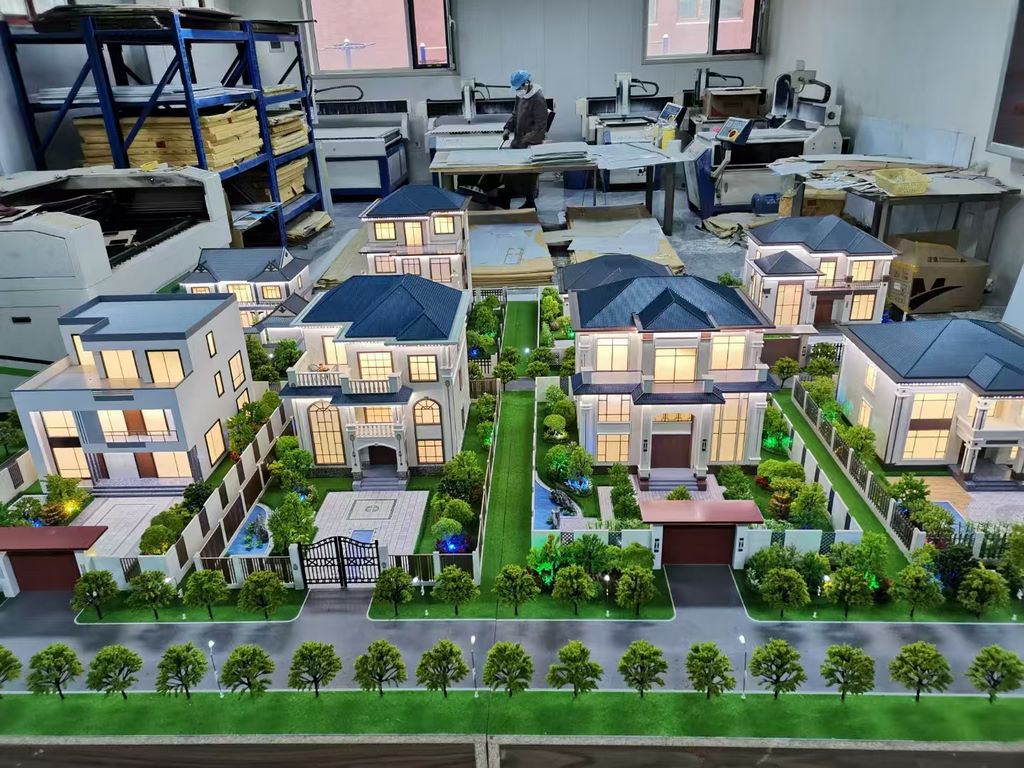
Five Applications for High Precision Sand Table Models
1. Real Estate Developer Sand Table Model – Luxury Sales Centers
A Real Estate Developer Sand Table Model for a penthouse tower needs flawless facade details.
Buyers expect perfection.
High precision delivers.
2. Custom Indoor Display Sand Table Model – Corporate Lobbies
A Custom Indoor Display Sand Table Model in a CEO’s office must impress at arm’s length.
Every window mullion and roof tile must be perfect.
3. Outdoor Exhibition Architectural Sand Model – Weather‑Resistant Precision
An Outdoor Exhibition Architectural Sand Model requires precision to ensure that sealed joints and drainage channels function correctly.
Even outdoors, the model must look sharp.
4. Large Project Sand Table Model OEM – Consistent Quality at Scale
For a Large Project Sand Table Model OEM order of multiple identical models, high precision ensures every unit matches the master prototype exactly.
No variation between units.
5. Custom Museum Exhibition Sand Table Model – Public Scrutiny
A Custom Museum Exhibition Sand Table Model in a history museum will be examined by thousands of visitors.
High precision ensures historical accuracy and durability.
Case Study: Precision Model Prevents $2M Construction Error
A developer planned a 50‑story tower with a twisted glass facade.
Each floor plate was unique.
They commissioned a Custom High Precision Sand Table Model at 1:100 scale.
During a design review, the model revealed that the elevator core on floor 25 did not align with the floor below – a 3mm error in the digital file (30cm real world).
The digital file was corrected before any steel was cut.
Construction rework cost was estimated at $2 million.
The model cost $18,000.
The savings were 100x.
Cost Factors for High Precision Models
Precision level – ±0.1mm costs more than ±0.5mm.
Complexity – Curved facades and intricate details add time.
Materials – Engineering resin and cast acrylic vs. MDF.
Quality control – Extra inspection hours.
Scale – Larger scales require more precision work.
Typical range: 50,000 for a complex structure with sub‑millimeter tolerances.
How to Choose a Manufacturer for High Precision
Use this checklist.
Equipment – In‑house laser cutters, CNC, SLA/DLP 3D printers.
Tolerance specification – They should state ±0.1mm or better.
Quality control – Do they use digital calipers and jigs?
Reference projects – Request examples of complex geometries.
Sample – Order a test piece before full production.
Common Mistakes to Avoid
Do not assume your digital model is perfect.
Check for non‑manifold geometry and zero‑thickness walls.
Do not use scaling after printing.
If your CAD file is in meters, check the STL export – one wrong unit and everything is 10x too big.
Do not combine low‑precision and high‑precision parts.
A 3D‑printed facade attached to a hand‑cut base defeats the purpose.
Do not skip the assembly jigs.
Even precision parts can be glued crookedly.
Future Trends in High Precision Sand Table Models
Multi‑material 3D printing – Print rigid and flexible parts together.
Micro‑laser sintering – Metal details at 0.05mm resolution.
Automated assembly robots – For ultra‑consistent glue lines.
Digital twin integration – The physical model and digital model linked via QR codes.
Conclusion
A Custom High Precision Sand Table Model is not for every project.
But when you need exactness – for complex designs, patent filings, or luxury presentations – nothing else suffices.
It protects you from costly construction errors.
It wins trust from demanding clients.
Whether you need a Real Estate Developer Sand Table Model for a penthouse sales center, a Custom Indoor Display Sand Table Model for a corporate lobby, an Outdoor Exhibition Architectural Sand Model for a public plaza, a Large Project Sand Table Model OEM for consistent quality across multiple units, or a Custom Museum Exhibition Sand Table Model for public scrutiny, high precision elevates every application.
Contact a precision manufacturer today.
Send your CAD files.
Get a tolerance quote.
Ready to order a custom high precision sand table model? Request a quote with your CAD files and tolerance requirements. Get a response within 48 hours.


