Sectional industrial engine model making suitable for exhibitions and trade shows
Case study on the production of sectional industrial steam turbine model
This project is a sectional industrial steam turbine model, based on a real steam turbine, using a semi sectional structure to visually display the internal rotor, blades, and shell structure. It accurately reproduces the mechanical transmission and core component form, achieving a realistic reproduction rate of over 90%. It is suitable for enterprise exhibition halls, technical teaching, and industrial science popularization scenarios.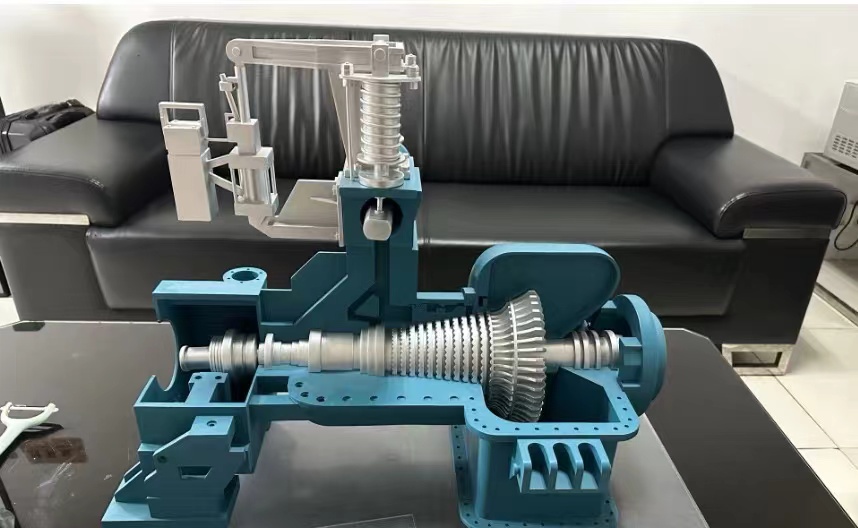
1、 Material selection
Main structure: The equipment shell is made of ABS board and 3D printed photosensitive resin, which balances structural strength and transparency in cross-sectional display; The internal rotor, blades, and transmission components are made of metal textured ABS and aluminum alloy profiles, simulating the metal precision texture of industrial equipment;
Auxiliary components: The valve stem, robotic arm, and connecting parts are made of stainless steel thin rods and 3D printed parts, restoring the details of mechanical linkage;
Base and auxiliary: The base is made of high-density wooden boards and matte PVC boards to ensure overall load-bearing and stability; Auxiliary materials include model specific adhesive, fine sandpaper, matte varnish, multi-color industrial paint, etc.
2、 Production process
Shell and profile shaping
Using ABS board as the base, a semi sectional shell is produced through cutting, bonding, and polishing processes to restore the outline and flange details of the box; Reserve rotor installation positions and observation windows to ensure clear visibility of internal structures.
Core component production
Using 3D printing photosensitive resin to integrate the rotor and blade assembly, finely polishing and restoring the blade texture and shaft segment structure; The valve stem and spring components are assembled with stainless steel thin rods and springs to simulate mechanical adjustment functions; The robotic arm and actuator are made through a hinged structure, retaining their movable characteristics.
Internal structure assembly
Embed the rotor and blade assembly into the shell, accurately align them, and fix them to ensure that the axis level is consistent with the transmission logic; Install the valve stem, spring, and robotic arm, adjust the linkage relationship according to the prototype layout, and restore the operating posture.
integral assembly
Assemble the shell, internal components, and base, adjust the center of gravity and balance, and ensure that the model is placed smoothly; Clean the splicing gaps to prepare for later coloring and protective treatment.
3、 Post processing and coloring
Main body coating: The equipment shell is sprayed with industrial blue matte paint to create a heavy industrial equipment texture; The internal rotor, blades, and shaft sections are coated with silver gray metallic paint, which simulates metallic luster and precision machining marks through gradient spraying;
Detail processing: The valve stem, spring, and robotic arm are sprayed with silver gray and light gray colors to enhance the recognition of the mechanical structure; The flange and bolt holes are dotted with dark gray to simulate assembly marks;
Identification and protection treatment: The component function identification is accurately pasted in the corresponding position through UV printing, which is clear and eye-catching; The overall matte varnish is sprayed to enhance the wear resistance and dust resistance of the model, while retaining the delicate texture of metal and plastic materials, avoiding the impact of overly bright paint on visual realism.
4、 Detail optimization and presentation of effects
Thoroughly polish and adjust the model, repair joint gaps, correct component spacing and linkage relationships, and ensure that the internal structure is consistent with the actual scene; Clean up surface impurities to make the appearance neat and uniform; Test the flexibility of moving parts to avoid jamming or loosening. The final product visually displays the core working principle of the steam turbine through a semi sectional structure, which is both ornamental and informative, meeting the diverse needs of technical teaching, enterprise display, and industrial popularization.


