Case study of proportion model production for container freight ships:
1、 Project Overview
This case study presents a static display model of a 1:100 scale container ship, with a total length of approximately 60cm (assuming a prototype length of 600m), mainly used for teaching demonstrations in maritime colleges (Dalian Maritime University). The model focuses on reproducing the exterior features of modern large container ships, including red and white colored hulls, fully loaded colored containers, and cranes and outfitting equipment on the deck.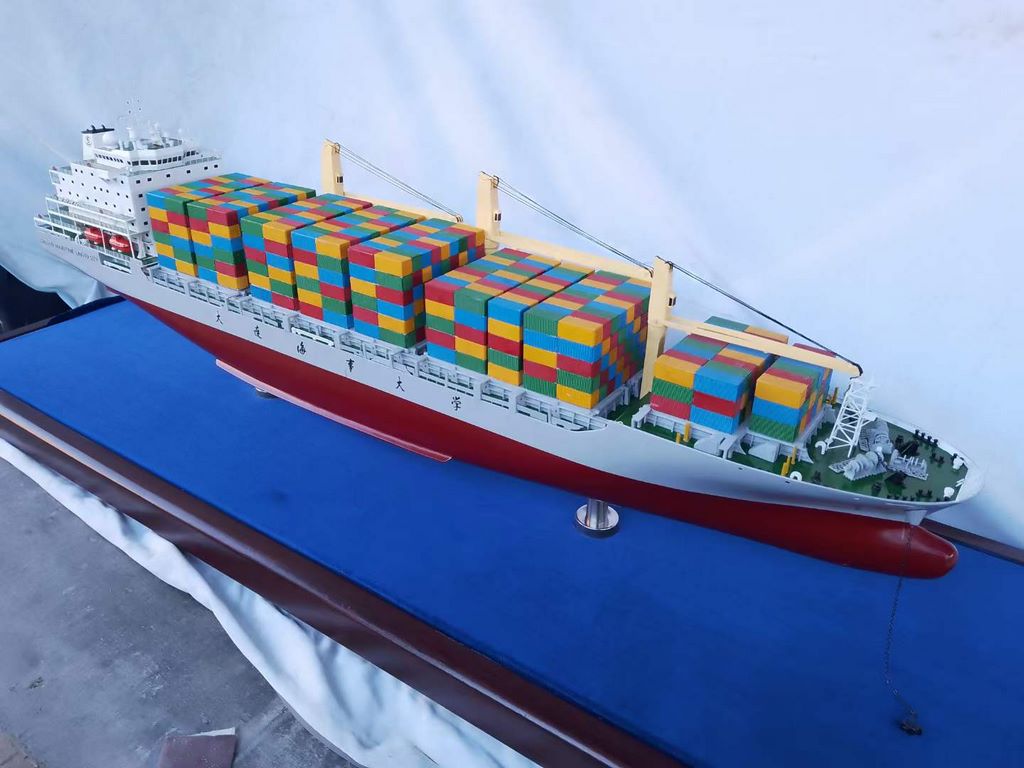
2、 Material preparation
According to the model production process and material selection suggestions, the following materials were selected for this production:
Hull and deck: 3mm thick ABS plastic sheet (used for cutting the hull outline and deck) and 2mm thick snowflake sheet (used for making internal structural supports).
Container and superstructure: 0.5mm thick ABS board (used for making thin-walled container structures) and 3D printed parts (used for complex superstructure and crane details).
Outfitting parts and railings: metal etching sheets (used for fine components such as railings and gangways).
Tools: Art knife, steel ruler, AB soil filling (used to fill gaps), sandpaper (800-1500 mesh), tweezers (used for small part installation).
Painting: water-based paint (red, white, yellow, blue, green), spray pen (used for large-area spraying), and masking tape (used for color separation).
3、 Production steps
1. Design and layout
Drawing preparation: Refer to the actual container ship's line drawing to determine the waterline length, width, and draft depth of the hull.
Proportional conversion: Calculate the dimensions of each part of the model at a ratio of 1:100.
Sample production: Use cardboard to make a sample, ensuring the symmetry of the ship's left and right sides, which is the foundation for ensuring the beauty of the model.
2. Shipbuilding
Cutting and Forming: Cut the ABS board into the side panel of the ship according to the design drawing, use a hot air gun or hot water softening to bend and form, and fit the ship's body line.
Assembly and soil filling: Bond the side panels and bottom plates of the ship, use AB soil to fill the joints and gaps, and after drying, sand them smooth with sandpaper to achieve a "seamless" effect.
Internal structure: Paste snowflake boards inside the hull as keel and rib supports to enhance the rigidity of the hull and prevent deformation.
3. Deck and superstructure
Deck laying: Glue the cut deck layer (3mm ABS) onto the hull frame, leaving room for hatch covers. Fill the edge gaps with small pieces of light wood or ABS strips and polish them flat.
Superstructure production: 3D printing or ABS board cutting is used to produce superstructures such as the driver's cab and living area. Pay attention to the proportion and position of each deck to ensure consistency with the prototype.
4. Container production
Mass production: Due to the large number of containers, standard container shells are made using laser cutting or 3D printing, or prefabricated small building blocks are used.
Painting and Stacking: The container is painted alternately in four colors: red, blue, yellow, and green, simulating the visual effect of a real port. Stick containers layer by layer on the deck according to the stacking pattern of "bottom horizontal and top vertical".
5. Outfitting and Details
Crane and jib: Use 3D printing or ABS board to make yellow shore crane, pay attention to the tilt angle of the jib and the simulation of the steel wire rope.
Railings and gangways: Use metal etching sheets to make railings, and simulate railing columns with thin copper or nylon wires. Install gangways and cable guides.
Text and identification: Write the words "Dalian Maritime University" in white paint on the bow and stern of the ship, and make a ship name plate.
6. Painting and Beautification
Primer: Spray gray or white water to fill the soil, check the surface flatness of the ship, and correct any defects.
Color separation spraying: First spray the bottom of the ship in red, then spray the top in white. Use masking tape to ensure clear boundaries.
Container coloring: Containers are individually sprayed with different colors, dried, and then stacked for installation.
Aging treatment: Use enamel paint for slight infiltration and aging to enhance the realism of the model.
4、 Achievement display
The model is ultimately fixed on a blue velvet base, simulating an ocean environment with coordinated overall proportions and rich details. It can be used for teaching demonstrations or as a school showcase.


