Analysis of Equipment Model Making Process
The production of equipment models needs to be combined with industrial design logic and process details, from material selection to post-processing, and each link needs to accurately reproduce the structure and function of the equipment. The following is a breakdown of the core production process: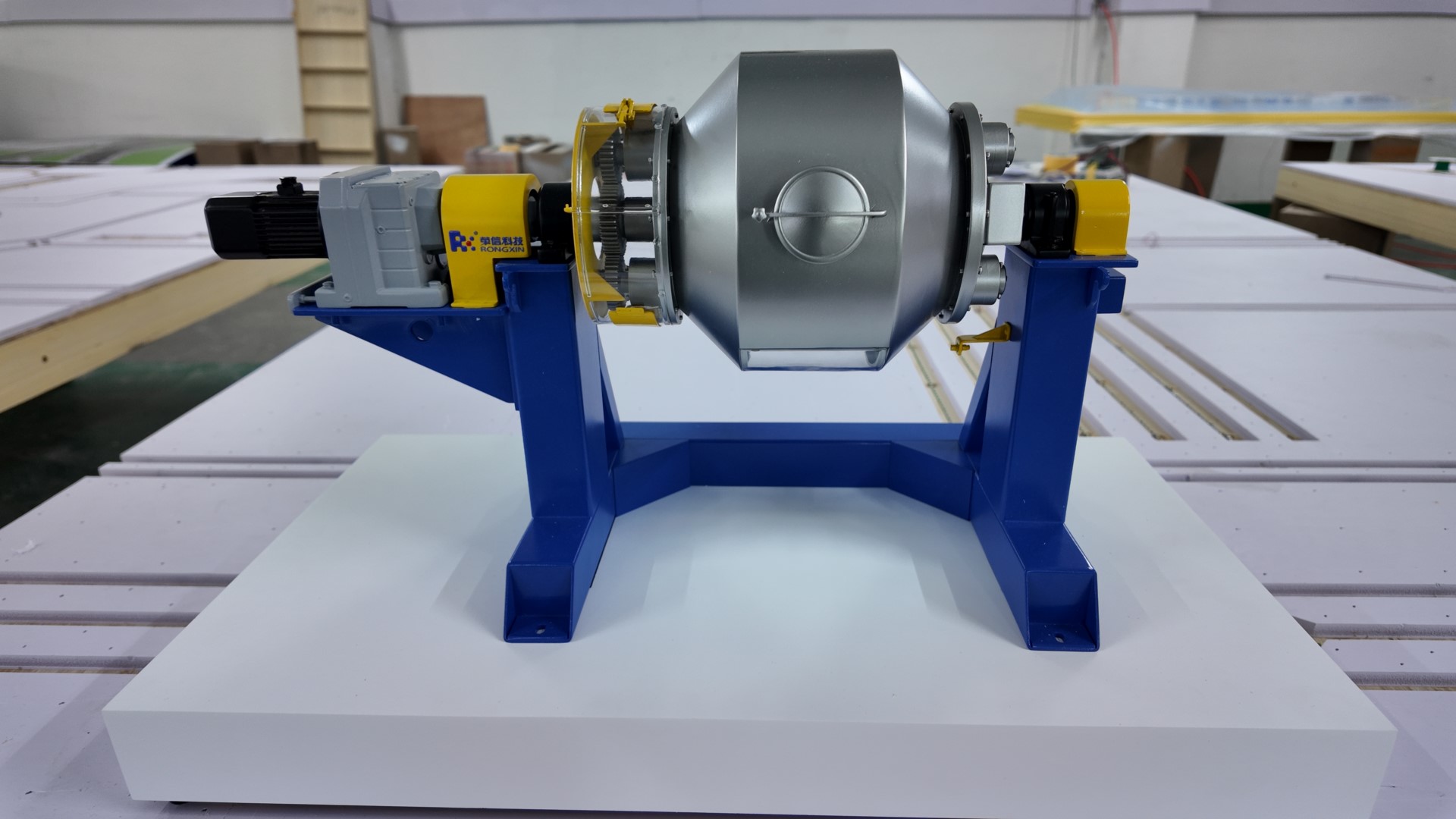
1、 Preliminary Preparation: Drawing Analysis and Material Selection
First, disassemble the equipment drawings to clarify the form of each component (such as the main compartment, power components, brackets, etc.).
Material selection:
Main compartment: Choose ABS plastic (easy to polish and color after printing, with a texture similar to metal);
Power components: made of engineering plastic (printed and painted in yellow to restore equipment identification);
Bracket: Choose PVC sheet (low cost, easy to cut, and simulates industrial blue paint after coloring).
2、 Core production process: step-by-step restoration of structural details
1. 3D printing molding (complex structure)
Use 3D printers to print complex structures such as main compartments and power components. Strictly control the layer height and accuracy during printing to ensure the smoothness of the cylindrical chamber and the gear engagement of the power components. After printing, clean the supporting structure with a small knife, and then use sandpaper (400 mesh → 600 mesh) to polish the surface, making the edges of the parts rounded and eliminating printing layer patterns.
2. Manual cutting and assembly (simple structure)
The blue bracket is cut from PVC sheet: first draw a line with a ruler, and then use a craft knife to accurately cut it;
During assembly, use hot melt adhesive to bond the bracket to the main compartment, adjust the angle repeatedly, and ensure that the support force of the bracket is consistent with the original equipment.
3、 Post processing: coloring and detail polishing
1. Base color spraying
Spray silver gray primer (simulating metallic texture) on the main compartment with a spray gun, yellow primer (restoring equipment identification color) on the power components, and industrial blue primer (simulating factory painting) on the brackets. When spraying, move the spray gun at a constant speed to ensure uniform color and no flow marks.
2. Detail coloring and aging
Main compartment: Use a fine bristled pen dipped in silver gray pigment to touch up the seams of the compartment, enhancing the metallic texture;
Power components: After the yellow primer dries, draw the equipment identification (such as the word "RX") with black paint, and then use transparent varnish for gloss treatment to restore the identification details of industrial equipment;
Bracket: After the blue primer dries, lightly sand the edges with sandpaper to simulate the "wear and tear" after long-term use, making the model more "industrial".
3. Overall polishing and buffing
After coloring, lightly polish the entire model with 800 grit sandpaper to eliminate brush marks; Then use a polishing cloth dipped in polishing solution to wipe, making the surface as smooth as a mirror and restoring the industrial texture of the equipment.
4、 Finished product presentation: Industrial model with 90% reduction degree
The final model was put on the display platform, and the metal luster of the main compartment, the identification details of the power components, and the industrial blue coating of the bracket were almost "identical" to the original equipment. After seeing it, the customer exclaimed, "It's a scaled down version of our factory equipment
From the blueprint to the finished product, every step hides a persistence in "restoration": the precision of 3D printing, the delicacy of manual cutting, and the layering of coloring, allowing the model to retain the hardcore texture of industrial equipment while adding a sense of "realism" due to detail processing. This is the 'magic' of industrial modeling - using craftsmanship and materials to turn drawings into tangible industrial memories.


