Case Study on Model Making of Construction Machinery Vehicle: Taking Crane Model as an Example
1、 Material selection: Balancing reduction and operability
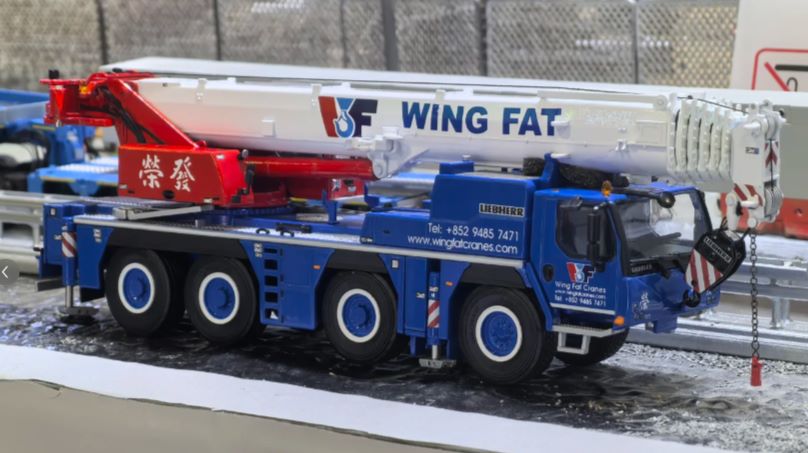
Before production, it is necessary to investigate the structural characteristics of the real crane (such as the blue and white color scheme of the body, red boom, identification text, etc.), and then select targeted materials:
Main frame: use light foam board to build the foundation structure, which is convenient for cutting and shaping;
Detail components: metal sheets (such as aluminum foil) simulate metal textured parts such as lifting arms and counterweights;
Decorative materials: stickers (including text, patterns, warning signs) restore the body text and visual elements;
Base: foam board+light wood board combination, which is light and stable.
2、 Production process: Step by step shaping of details
1. Framework construction
First, use foam board to cut the outline of the body, boom, counterweight and other large parts, and splice them into the crane foundation form. During the process, it is necessary to repeatedly compare real crane photos to ensure proportional coordination (such as the length of the body and boom, wheelbase, etc.).
2. Detail shaping
Metallic texture components: Cut metal sheets into the shape of lifting arms and counterweights, and polish the edges smooth;
Small component assembly: make small parts such as wheels, hooks, warning signs, etc., and stick them to the corresponding positions with glue;
Structural reinforcement: use glue+foam plate to support the key joints (such as boom and body) to ensure the stability of the model.
3、 Post processing: coloring and detail polishing
1. Spray painting and coloring
Base color treatment: The main body of the car is sprayed in blue, the boom is sprayed in red, and the base is sprayed in light gray, simulating the color style of a real crane;
Detail layering: After the base color is dry, spray the text area on the car body with white paint, and then hand draw the text such as "WING FAT" and "Tel:+852 9485 7471" with black paint to ensure clarity and accurate positioning of the text.
2. Detail polishing
Edge treatment: Use sandpaper (from coarse to fine) to polish the edges of components such as the car body and crane arm, remove cutting marks, and make the surface of the model smooth;
Texture enhancement: Apply silver metallic paint to metal components such as wheels and suspension arms to simulate real metallic luster;
Defect correction: Use white paint to repair uneven spraying, and use black paint to complete the identification details, making the model restoration close to 90%.
4、 Finished product display: balance between restoration and realism
The completed model is highly similar to the real crane in terms of body color matching, boom shape, text identification, etc., and the details (such as warning signs and hooks) are also accurately restored. Through material selection, step-by-step process, and fine post-processing, the operability of the production is ensured, and a restoration degree of about 90% is achieved, making the model both aesthetically pleasing and realistic.


