Case study on the development of industrial waste gas treatment model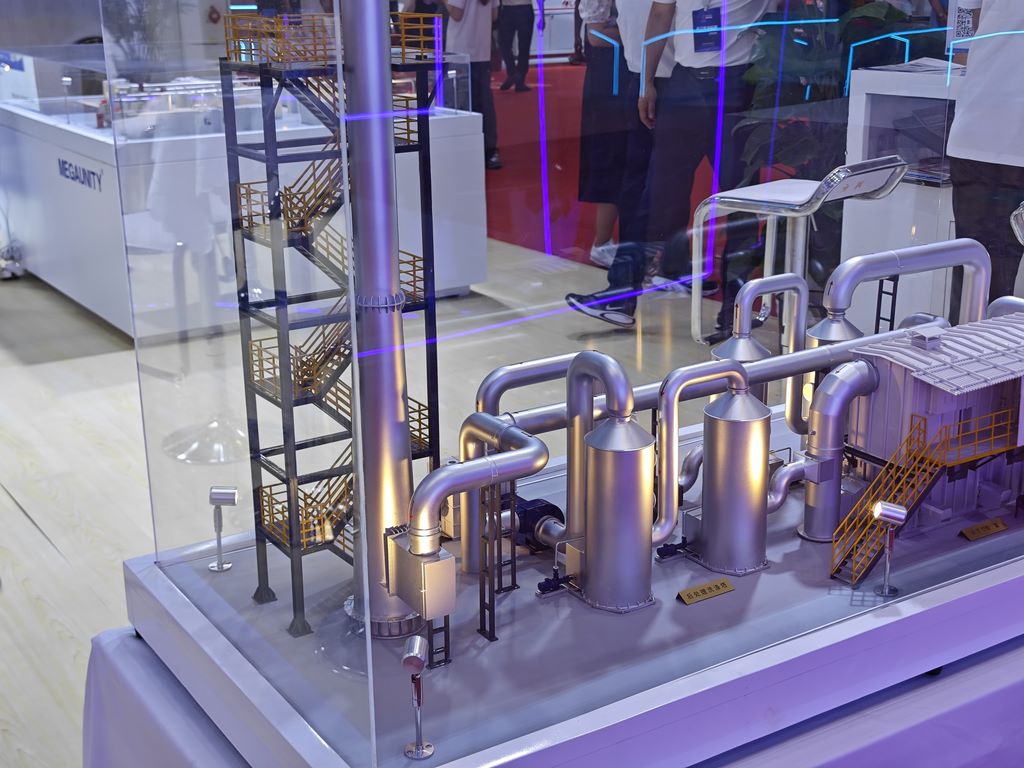
1. Preliminary preparation: Analysis of drawings and material selection
Before production, it is necessary to deeply analyze the process drawings of industrial waste gas treatment equipment, clarifying the structural proportions and functional logic of core units such as absorption towers, activated carbon adsorption tanks, catalytic combustion devices, and chimneys. In terms of material selection, priority should be given to environmentally friendly and easily processable materials:
Tower body and tank body: Select PVC board (lightweight and easy to shape, simulating the main body of the equipment);
Pipes: Use PVC pipe material (conforming to the cylindrical shape of industrial pipes);
Support/Ladder: Choose metal wire (such as iron wire, copper wire, to restore the equipment support structure);
Detail components: such as valves, instruments, and signboards, should be made using 3D printing or hand carving (to enhance precision).
II. Manufacturing Process: Step-by-Step Restoration of Core Structure
1. Forming of tower body and tank body
Cut the PVC board according to the scale specified in the drawing. Use hot bending and splicing techniques to shape the cylindrical/conical contour of the tower body. For the tank body, ensure the structural rationality of the top sealing and bottom support. When cutting, use a utility knife and ruler for precise positioning. When hot bending, use a heat gun to evenly heat the edges of the board and slowly bend it to the angle specified in the drawing to avoid deformation.
2. Construction of piping system
After cutting the PVC pipe to the length specified in the drawing, connect it with pipe joints and elbows to form an exhaust gas conveying network. The key is to control the "layered sense" of the pipeline routing - the main pipe runs on the bottom layer, and the branch pipes run upwards layer by layer, simulating the three-dimensional layout of the actual device. The connections are fixed with glue to ensure there is no "misalignment".
3. Installation of supports and ladders
The metal wire is bent into a bracket (to support the tower body and tank body) and a ladder stand (to restore the maintenance access of industrial equipment) according to the proportion specified in the drawing. During installation, the bracket is first fixed, and then the connection between the ladder stand and the tower body/tank body is reinforced with glue to ensure overall stability.
III. Post-processing: coloring and detail refinement
1. Spraying of primer and main color tone
First, evenly spray the model surface with white primer. After it dries, paint it according to the color specifications for industrial equipment:
Absorption tower and activated carbon tank: Choose the commonly seen silver gray color in industry (to simulate a metallic texture);
Pipes: Choose dark gray (to restore the "industrial style" of the pipes);
Support/Ladder: Choose yellow (a warning color commonly used in industrial equipment).
During spraying, use a fine nozzle to achieve even coverage, and utilize masking tape at the edges to assist and prevent color spillage.
2. Detail enhancement and logo addition
Valves/Instruments: Apply black paint in spots to simulate the control components of the equipment;
Signboard: Print words such as "Absorption Tower" and "Activated Carbon Adsorption Tank", and affix them onto the corresponding equipment;
Texture enhancement: The surfaces of the tower and tank bodies are polished with fine sandpaper to achieve a metallic luster, while the pipelines are treated with matte paint to restore the "industrial texture" of industrial equipment.


