1. Project Background and Process Design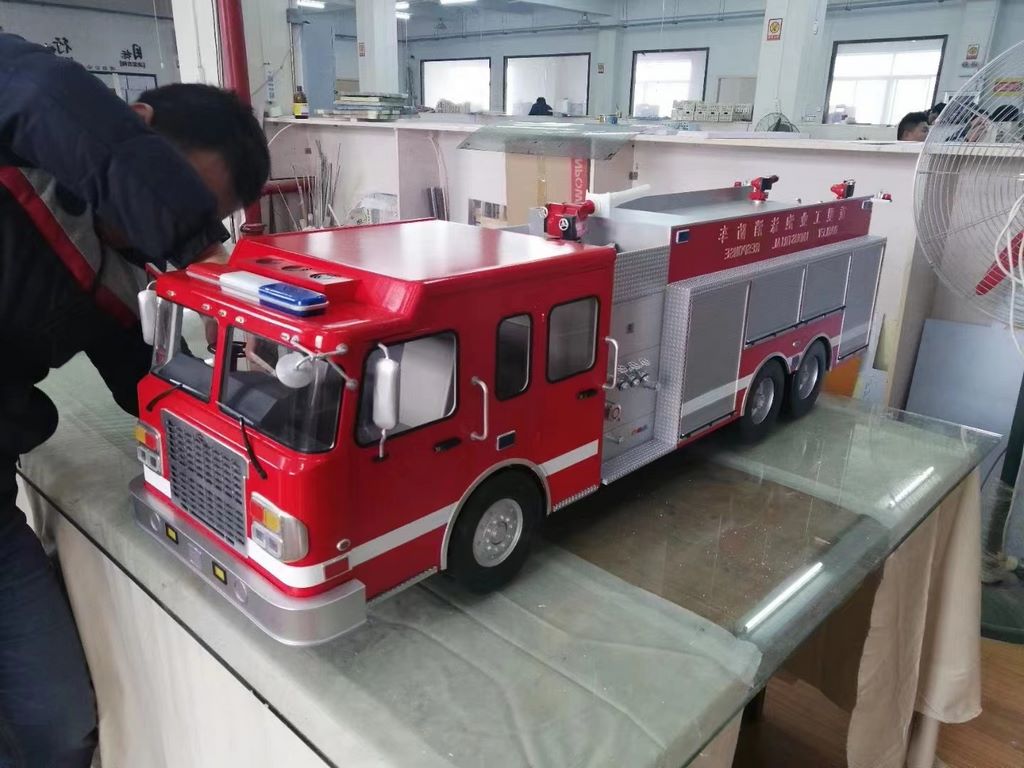
This case study uses a fire rescue brigade vehicle from a certain city as the prototype and reproduces it at a scale of 1:18. After obtaining the original data through 3D scanning, the engineering team modularized the vehicle body structure to ensure that the assembly accuracy error of each component was ≤0.3 mm, achieving a 90% reproduction standard.
2. Core Production Process
Skeleton Casting
Material Selection: The main frame is made of zinc alloy die-casting (ZA-12), melted at 850°C and poured into steel molds, then cooled and CNC-machined to correct deformation.
Structural Reinforcement: 304 stainless steel sleeves are embedded in load-bearing areas such as door hinges and ladder bases to enhance the durability of moving components.
Exterior Component Manufacturing
Injection Molding: Transparent polycarbonate (PC) components (e.g., headlight covers) are produced using a two-color injection molding process, with an inner layer treated to prevent light distortion.
Etched Sheet Application: Microtextures on grilles and warning signs use 0.2mm brass etched sheets, positioned using cyanoacrylate adhesive.
Functional Component Assembly
Ladder System: 21 aluminum alloy ladder sections are laser-cut, with each section incorporating miniature bearings to ensure smooth extension and retraction.
Rotating warning light: The 3D-printed resin lampshade integrates a magnetically controlled rotating mechanism, with a rotation speed matching the standard 30 rpm of the actual vehicle.
III. Surface treatment process
Primer treatment: After electrostatic spraying of epoxy primer, it is baked at 60°C for 30 minutes to form a uniform 0.1mm film layer.
Color-Separated Spraying: Using Tamiya TS spray cans (Fire Red TS-49 + Matte Black TS-6) for masking spraying, with 0.3mm masking tape used to precisely demarcate the boundaries.
Weathering Effects: On areas prone to wear, such as door handles and exhaust pipes, enamel paint staining and dry brushing with pastel colors are used to simulate signs of use.


